
Product feature
Model Drift
Spot when data or results start to shift.
Catch your models drifting before your decisions do
Models don't fail all at once. They drift slowly and quietly, as the world their training data described stops matching the world they run in. AI & Partners measures that drift feature by feature, alerts the right people when it crosses a threshold, and shows exactly where it started.
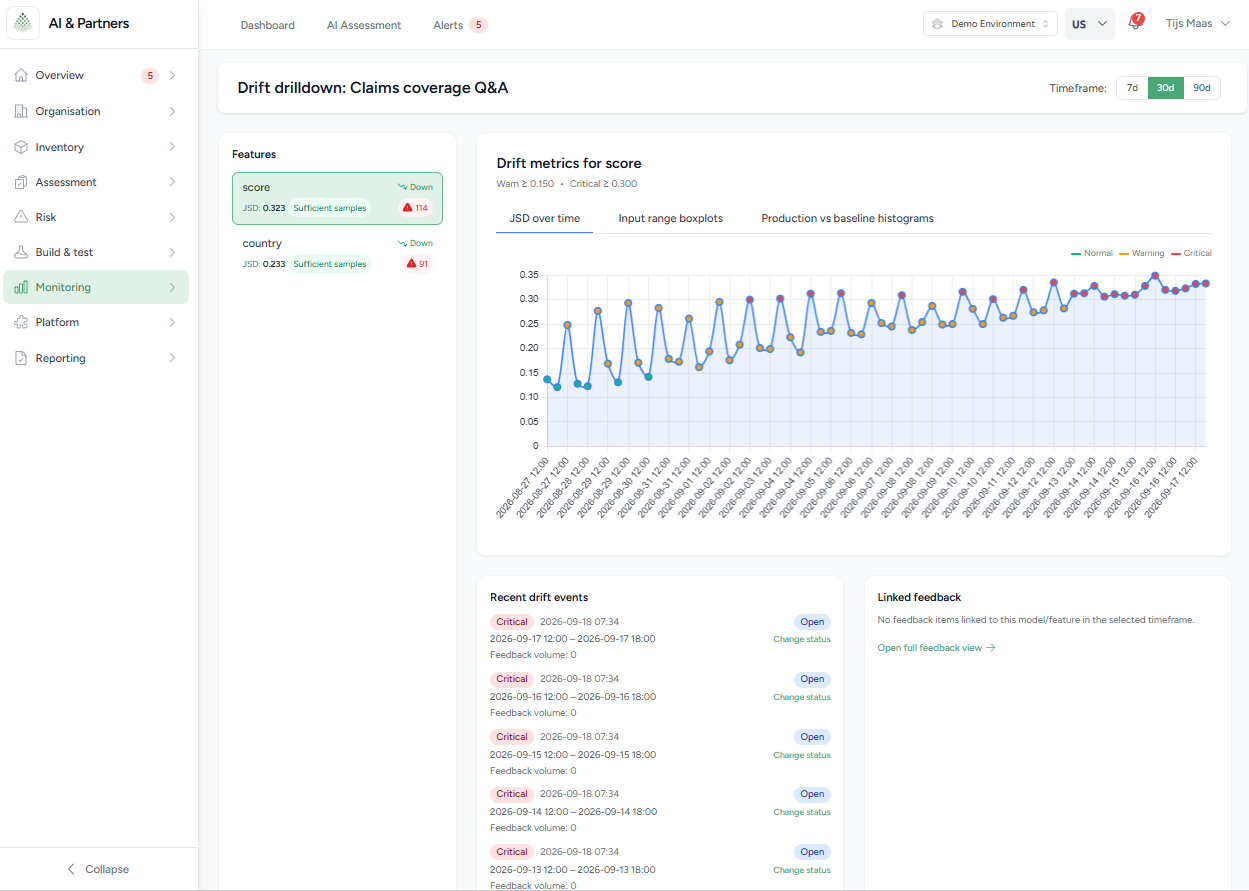
Feature drift (JSD)
score feature · CriticalDemo environment · illustrative figures
Is the model you deployed still the model you have?
A model that was accurate at launch can be quietly wrong six months later without a single error in the logs. Input data shifts, customer behaviour changes, a new region comes online, and the model keeps answering with the same confidence it always had. By the time the outcome data catches up, the damage is already in the decisions.
No early warning: drift only shows up when outcomes go wrong
No way to tell which feature is driving the change
Retraining decisions made on instinct, not evidence
Features
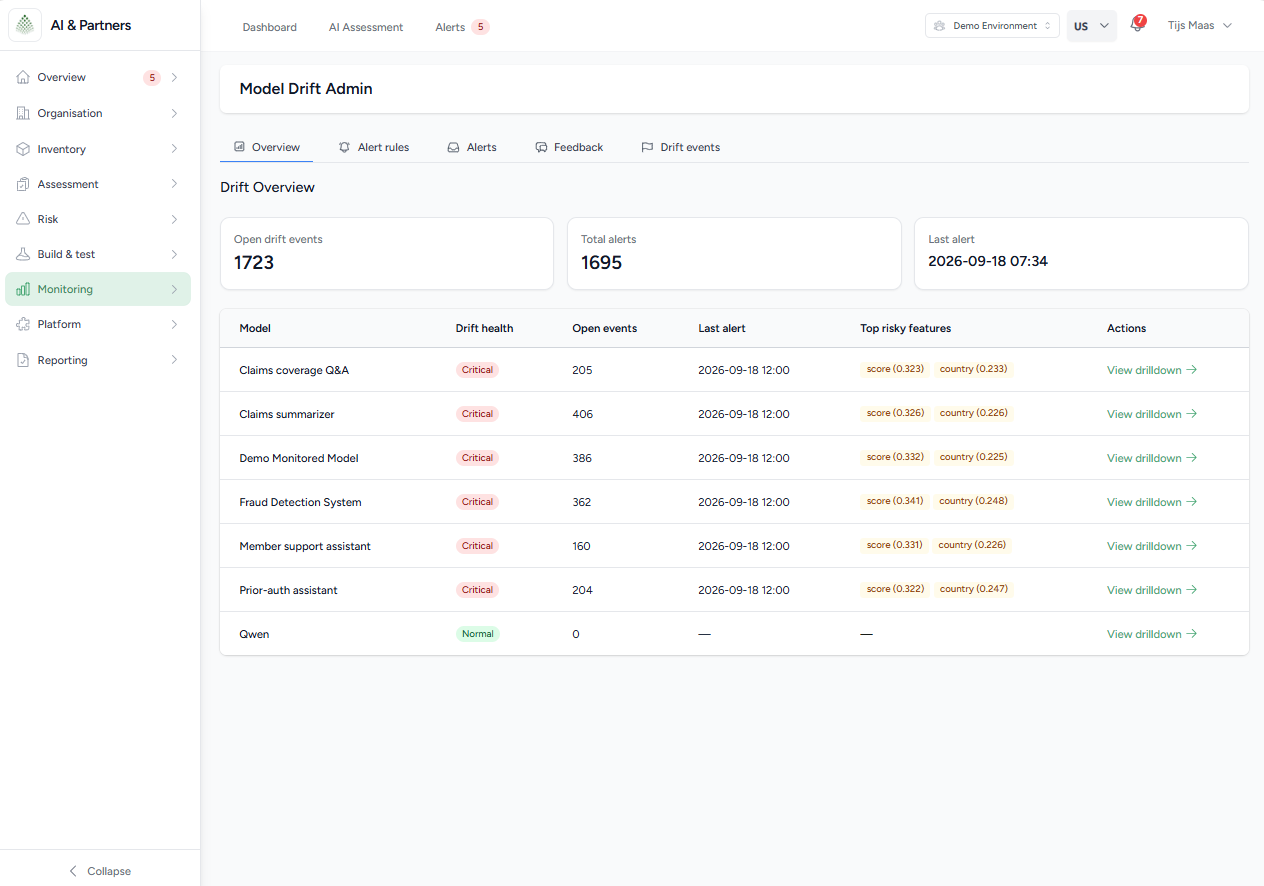
Drift detection that tells you what, where and how much
Every monitored model, listed with its drift health (Normal, Warning or Critical), open drift events, last alert and riskiest features. The team sees at once which models are stable and which are moving.
For your team
What this means for you
- Get an early warning weeks before drift shows up in outcomes
- Know exactly which feature moved, by how much and since when
- Retrain when the data says so, and show why
- Set thresholds that match the risk of each model
- Keep a record of drift events that proves ongoing oversight
How it works
Four steps, running continuously
- 1
Step 1
Set a baseline
- 2
Step 2
Measure each feature (JSD)
- 3
Step 3
Flag Warning or Critical
- 4
Step 4
Drill down and decide whether to retrain
Try it
Set your own drift thresholds
Drag the Warning and Critical thresholds and watch the sample drift line recolour.
Date (daily, last 20 days)
Drift: how far today's data has moved from the data the model was trained on. 0 means no change; higher means the model is seeing unfamiliar data.
Illustrative data
Let's Get Started
See drift detection running on one of your own models.
Book a DemoModel Drift in Action
Where a slow shift in the data becomes a fast problem.
Insurance Claims and Underwriting Models
Catch shifts in claim patterns before pricing goes wrong.
Fraud Detection Systems
Know when fraud tactics change before the model falls behind.
Demand Forecasting and Pricing
Spot changing buying patterns before forecasts miss.
Prior-Authorisation and Triage Assistants
Flag changes in requests before decisions drift from policy.
Frequently asked questions
Let's Get Started
See drift detection running on one of your own models.
Book a Demo